Preparing a Witness Statement

- Duration
- 17 minutes
- Format
- Video
- Template
- Included
Written by Julia Gidney · former leading employment lawyer.
Purchase a single Video Guide or purchase all 12 Video Guides for £299 · save £76.88
▸ Read the video transcript
The witness statement you deliver to the Employment Tribunal, is an incredibly important document.
It's your evidence, given under oath, and you usually won't have the chance to add to it, so it needs to be clear, accurate, and complete.
In my video guidance, my favourite avatar Ada, will explain when and how you need to make a start on preparing your statement, and why it's so important to take personal responsibility for what it says, even if someone helps you prepare it.
We'll look at how to structure your statement, what it needs to include, and how it will be used.
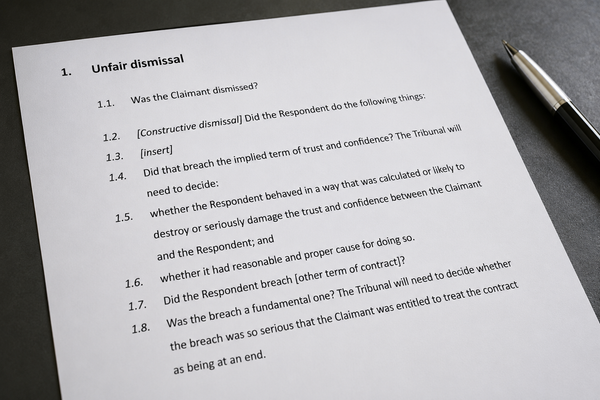
We'll walk through what to include for three common types of claim: unfair dismissal, race and sex discrimination, and discrimination arising from disability.
The video also comes with a template witness statement, to help you to make a start. Thanks for watching.
What This Video Guidance Covers
Structure your evidence the way a Tribunal expects to see it, in your own words, without missing what actually matters.
Content includes:
- 1 Why your witness statement is so important
- 2 When to make a start on it
- 3 How it fits within the Tribunal 'directions' order
- 4 Aligning the witness statement with the List of Issues and the agreed bundle
- 5 The statement format and structure the Tribunal would like to see
- 6 Sample content for the 3 most common types of claim
- 7 Making sure it is complete
- 8 Addressing every issue in the List of Issues
- 9 Cross-referring to the bundle
- 10 Drafting, exchange and filing
- 11 How the statement will be used by the Tribunal
- 12 What to expect in cross-examination
- 13 Using the witness statement template
Good to Know
Who is this video for?
Anyone with an Employment Tribunal claim in England & Wales who needs to write a witness statement, whether that's your own statement as the Claimant, or a statement from a colleague or other witness giving evidence on your behalf.
What's included?
A 17-minute video explaining why your witness statement matters so much, when to start it and how it fits with the Tribunal's directions, the List of Issues and the agreed bundle. It sets out the format and structure the Tribunal expects, then shows you how to approach the content for the three most common types of claim: unfair dismissal, race or sex discrimination, and discrimination arising from disability, from both the Claimant's and the employer's side so claimants can anticipate responses. It finishes with how your statement will be used at the hearing and what to expect in cross-examination.
What templates come with it?
Downloadable template witness statements, so you can see the structure and use them as your starting point.
Will I get to read my statement out at the hearing?
No, and that changes how you need to write it. The video explains what this means for your preparation.
There's some tricky content I'm worried about – can I leave it out?
The video gives clear guidance on this and on how to handle unhelpful facts in a way that protects your credibility.
Does it cover cross-examination?
Only from the witness statement's point of view: what you should expect to be asked about and why the statement and the bundle need to be prepared together with that in mind. Our module Giving Evidence in an Employment Tribunal covers the hearing itself in full.
Is it up to date?
Employment law, the Acas Code and Tribunal rules change regularly. We monitor these changes closely and update our videos when they happen. If we update this video, the new version appears in your personal video dashboard automatically, at no extra cost.
How long will I have access?
Employment Tribunal cases can take a long time to reach a hearing, so your video stays available to you for 24 months. If you need longer, just email us at info@wdidi.org and we'll extend it for you. We want you to have our guidance for as long as you need it.
Is this legal advice?
No. None of our guidance is legal advice. If you need advice on your own case, please contact a solicitor or other qualified representative. The Law Society's Find a Solicitor service is a good place to start — or your local Citizens Advice if cost is a concern.
Anything else?
More questions? Our full FAQ is here.