
Worried about getting your ET1 wrong? It's simpler than it looks.
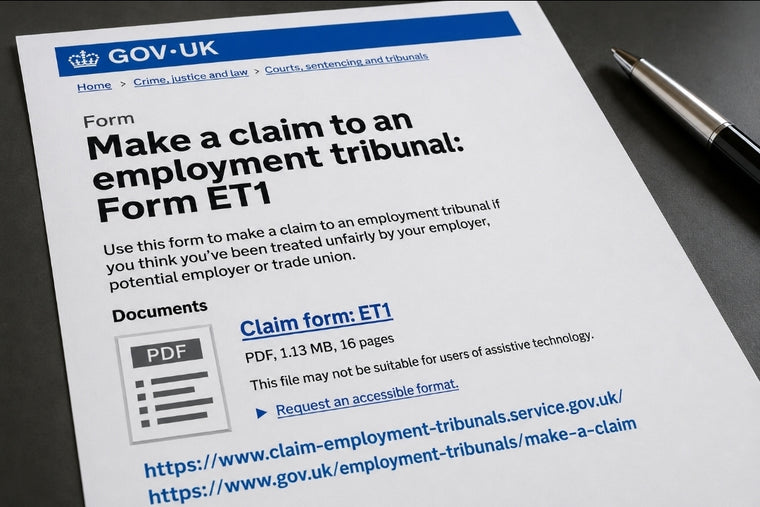
The ET1 is just a form that sets out who you are claiming against, what happened and what you want. Our Video Guide breaks it into small, plain-English steps so you know what to write.
- No fee to submit an ET1
- Plain English, no legal jargon
- Know what to write in every section
- A 25-minute walkthrough. Instant access, so you can watch tonight.
Created by Julia Gidney, a former leading employment law partner, and written for people with no legal background.
Getting Started: Your Tribunal Claim
For England & Wales only
- Section-by-section ET1 video walkthrough
- Plain-English explanation of each question
- How to set out your account clearly
- How time limits and ACAS early conciliation work
Instant access. Secure checkout. · Details
The questions almost everyone asks first
If you're feeling nervous, that's normal. Here are straight answers.
Can I really do this myself?
You don't need a law degree. You need to know what to do, in what order and when. The ET1 is a form with questions to answer one at a time, and our Video Guide walks you through each one.
Will I be bullied by my employer's legal team?
The Employment Judge keeps the process fair, even when only one side has a lawyer. Knowing what to do and when makes you harder to bully. The ET1 is simply your side of the story, set out clearly.
Will this overwhelm me?
Not when you work to a plan. Take the form one part at a time and you can feel confident rather than overwhelmed.
Is it really free, or will this cost me?
There is no fee to submit an ET1. A small number of cost risks exist later in a claim, but they are rare and depend on specific circumstances.
What if I get it wrong?
Changing your claim after you file usually needs the tribunal's permission, so it is worth taking a little time now. That is what the Video Guide is for.
Do I need to be good at writing?
No. The Tribunal wants clear facts in order: what happened, when and who was involved. You don't need clever wording.
It's six small jobs, not one big one
You don't write a legal essay. You answer questions in turn. Here are the main parts of the form, and what each is really asking.
About you
Your name, address and contact details.
In plain English: The easy one. Use details where you can be reached while your claim runs.
About your employer
Who you are claiming against, and their address.
In plain English: Use your employer's full legal name, as it appears on your ACAS certificate.
Your job and pay
When you started and finished, your role, your pay and your notice.
In plain English: Grab your contract and payslips and have the dates to hand.
The type of claim
The box or boxes that match your complaint, such as unfair dismissal, discrimination or unpaid pay.
In plain English: Tick every type you intend to bring. Adding one later usually needs permission.
What happened
Your account of events, in your own words.
In plain English: Short paragraphs, in date order: what happened, when and who was involved.
What you want
The outcome you are asking the Tribunal for.
In plain English: For example compensation or getting your job back. Say clearly what you want.
Before you open the form: three quick steps
Do these first and the form itself goes much faster.
Contact ACAS first
In most cases you must notify ACAS and go through early conciliation before you can claim. ACAS then gives you a certificate number, which you will need on the ET1.
Estimate your time limit
Use the estimator below for a rough date, then check the dates on your ACAS certificate. Missing the time limit can end a claim before it starts. This is an estimate, not legal advice, so always check your own deadline with ACAS or a qualified adviser as soon as you can.
Gather your details
Have your employer's full legal name and address, your employment dates and pay, a timeline of events, and a clear idea of the outcome you want.
Estimate your time limit
For most claims the time limit is 3 months less one day from the act you are complaining about, or 6 months less one day if the act happened on or after 1 October 2026. For most claims you also need to contact ACAS for early conciliation before you can submit your ET1. Contacting ACAS does not start your Tribunal claim; your ET1 does. Enter your dates for an estimate.
This is an estimate, not legal advice. Time limits can change, for example during ACAS early conciliation, and only the Tribunal can decide whether a claim is in time. Always check your own deadline with ACAS or a qualified adviser as soon as you can. Some claims, such as breach of contract or redundancy pay, have different time limits and a few claims are exempt from early conciliation.
The legal words, in plain English
You will see these words on the form. They are less scary than they sound.
Get through your ET1 with confidence
Watch at your own pace, pause when you need to, and fill in your form as you go.
- Section-by-section ET1 video walkthrough
- Plain-English explanation of each question
- How to set out your account clearly
- How time limits and ACAS early conciliation work
Easy mistakes to avoid
- Missing the deadline. Most claims have a short time limit, so check your dates before you start.
- No ACAS certificate. A missing certificate number, or an employer name that does not match it, can get a claim rejected.
- A long story with no dates. Set out facts in order: what happened, when and who was involved.
- Leaving out a claim type. Adding one later usually needs the tribunal's permission.
- Not saying what you want. Say what outcome you are asking for, such as compensation or reinstatement.

Julia Gidney
Former leading employment law partner
Julia created Tribunal-Ready to make the Employment Tribunal process less intimidating for people representing themselves. Every Video Guide is written in plain English, with no legal jargon and no assumed knowledge.
Need help beyond the ET1?
The Full Series covers the 12 key stages of your claim, from early conciliation to the hearing.
More questions
What is the ET1 form?
The ET1 is the claim form that starts a case in the employment tribunal. It sets out who you are claiming against, what happened and what you want.
Do I have to contact ACAS first?
In most cases yes. You normally need an early conciliation certificate number from ACAS before the Tribunal will accept your claim, although some claims are exempt. Check the ACAS and GOV.UK guidance for your situation.
How long do I have to submit my ET1?
Most claims must now be started within 6 months less one day of the act you are complaining about (3 months less one day if it happened before 1 October 2026), with the clock paused during early conciliation. Some claims, such as breach of contract or redundancy pay, have different limits. Check your own dates carefully.
Do I need a solicitor?
No. Many people complete the ET1 themselves. Our Video Guide is general educational guidance, not legal advice, so consider speaking to an adviser if your case is complex.
What happens after I submit it?
The Tribunal sends your claim to your employer, who normally has 28 days to respond using an ET3 form. The Tribunal will then give directions on the next steps.
Can I change my ET1 after I have filed it?
You usually need the tribunal's permission to change or add to your claim, so it is worth getting it right first time.
You don't need a law degree. You need a plan.
Take it one section at a time and give your claim the strongest start.
Get the Free ET1 Video Guide